Interstellar comet
3I/ATLAS
A comet from another star: the third body ever seen passing through the solar system from outside. SPHEREx caught it in August 2025 on its way in, and again in December 2025, six weeks after it had passed the Sun.
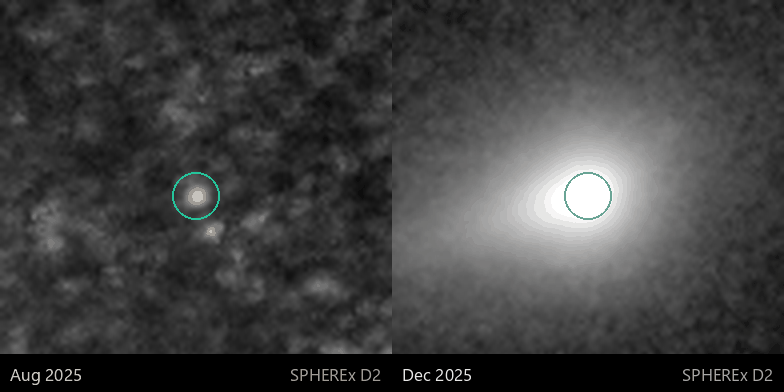
It was reported on 1 July 2025 by the ATLAS survey telescope in Río Hurtado, Chile. It moves too fast for the Sun to hold it, which is how astronomers know that it came from outside: the third such body ever found, after ʻOumuamua and Borisov. It passed closest to the Sun on October 29, 2025, at 1.36 times the Earth’s distance from the Sun, and closest to the Earth on December 19, 2025, at 1.8 times that distance. SPHEREx had it in view twice: on its way in (August 1 – 15, 2025) and on its way out (December 8 – 15, 2025).
What to look for
Every image is centred on the comet, so it stays in the middle while the stars behind it change. In August it is a faint dot; in December it is more than twenty times brighter and has a tail. In the spectrum under the images, the points that stand far above the rest near 4.3 microns are carbon dioxide gas glowing around the comet. In December water vapour (2.7 microns) and carbon monoxide (4.7 microns) glow as well.
What the exposures show
A gas around a comet takes up sunlight and gives it back at its own wavelengths. The table says how many times as bright the comet is inside the band of each gas as in the plain spectrum beside it. It is worked out from the exposures themselves, by the code this site runs when the comet is opened.
| Gas | Band (µm) | August 2025 | December 2025 |
|---|---|---|---|
| Water vapour H₂O | 2.60–2.76 | no clear glow | ×3.6 |
| Organic molecules C–H | 3.25–3.55 | no clear glow | ×2.7 |
| Carbon dioxide CO₂ | 4.20–4.33 | more than ×100 | ×49 |
| Carbon monoxide CO | 4.58–4.80 | no clear glow | ×3.1 |
The SPHEREx team, with a far more careful analysis of the same exposures, reports carbon dioxide and water vapour for August and, for December, a comet much more active than before, with water vapour, organic molecules, carbon dioxide and carbon monoxide, and cyanide (CN) besides.
Is it really the comet?
Each exposure is cut out around the place that NASA’s JPL Horizons gives for the comet at the middle of that exposure, seen from where the satellite was at that moment. In 38 exposures of December in which the comet is bright, its light lies typically 0.3 arcseconds from that place, and 0.5 at the worst; one SPHEREx pixel is 6.15 arcseconds. IRSA, the archive that keeps the SPHEREx images, publishes its own list of the exposures that contain the comet: of its 259, this site has 258, and six more (compared on 21 November 2026).
SPHEREx has 264 exposures of it: 160 (August 1 – 15, 2025) and 104 (December 8 – 15, 2025).
Open 3I/ATLAS in ChronosphereX
Sources: IRSA: SPHEREx observations of Comet 3I/ATLAS · NASA: Quick Facts about 3I/ATLAS · JPL Horizons · Lisse et al., arXiv:2512.07318 · Lisse et al., arXiv:2601.06759 · Wikipedia