Planet X
Planet X, Pluto and SPHEREx
The search for a planet beyond Neptune found Pluto in 1930. How it was found, what astronomers predict today, and whether NASA’s SPHEREx could see it.
Why look at the same place twice?
Because objects can move or change. In 1930, Clyde Tombaugh discovered Pluto by comparing two photographs of the same patch of sky and spotting a dot that had shifted. SPHEREx repeatedly observes hundreds of millions of stars and galaxies, far too many for one team to inspect. The more people who help compare the images, the more likely we are to spot something interesting.
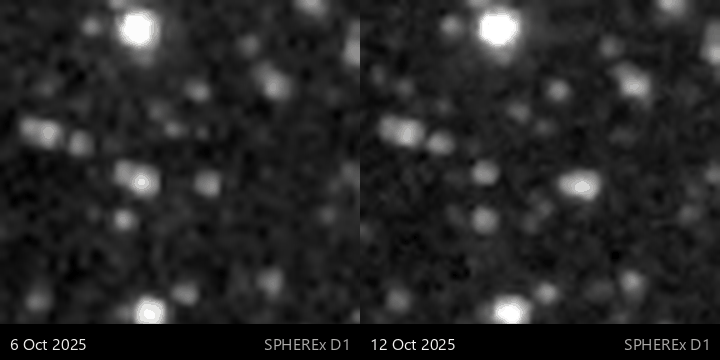
Planet X
Tombaugh found Pluto while searching for a “Planet X” that had been predicted beyond Neptune. Today the name belongs to another prediction: in 2016, astronomers at Caltech showed that the most distant small bodies of the solar system are aligned in a way that the gravity of an unseen planet would explain. By NASA’s account it would have 5 to 10 times the mass of Earth, orbit 20 to 30 times farther out than Neptune and take 10,000 to 20,000 years to go around the Sun. Nobody has seen it: it remains a hypothesis.
Could SPHEREx see it?
Probably not. Astronomers measure brightness in magnitudes: the larger the number, the fainter the object. One magnitude is 2.5 times fainter; five magnitudes are exactly 100 times. The faintest dot in a single SPHEREx exposure is about magnitude 19. Planet X is predicted at magnitude 22 to 25, which is 16 to 250 times fainter, and searches down to magnitude 21 have not found it. But whatever is brighter and moves, SPHEREx records: it can be found the way Pluto was.
A ladder of brightness
- −1.5 Sirius, the brightest star
- 6 faintest star the eye can see
- 9.5 Barnard’s Star
- 15 Pluto
- 19 faintest dot in one SPHEREx exposure
- SPHEREx stops here
- 22–25 Planet X, as predicted
One magnitude is 2.5 times fainter; five are 100 times.
How cold worlds are found today
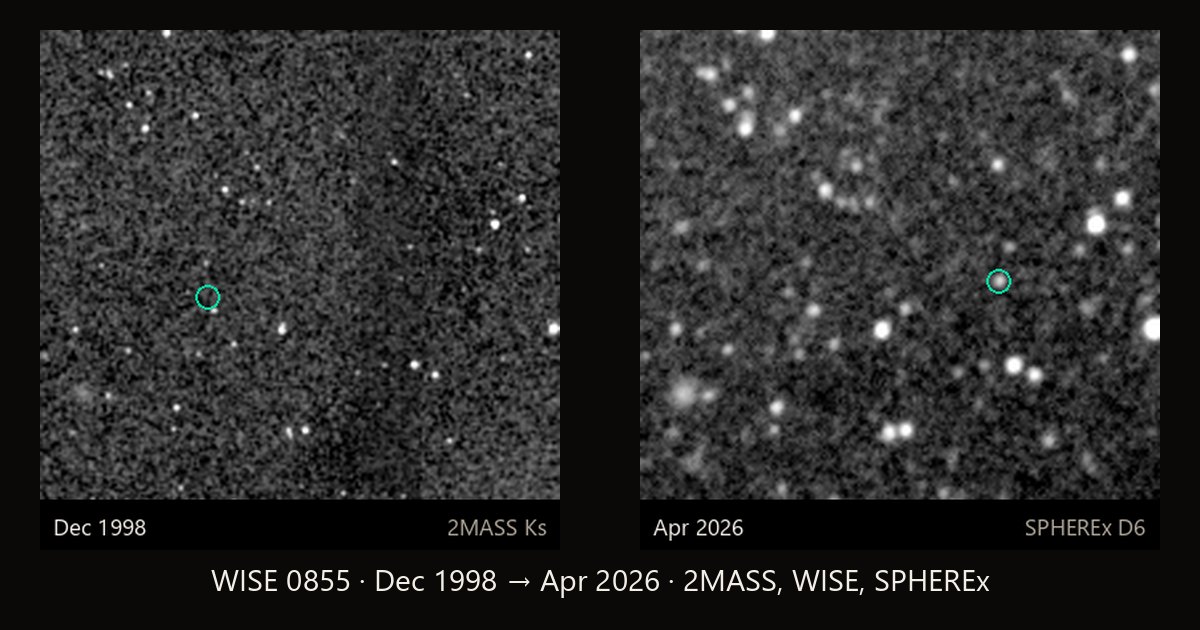
A world beyond Neptune, or a cold brown dwarf near the Sun, gives itself away as Pluto did: it moves. Today the search runs on infrared images taken years apart. WISE 0855, the coldest brown dwarf known, was found in 2014 by its motion in the images of WISE; in the image 2MASS took of its place in 1998 nothing shows, as it is too cold to shine at 2.2 microns. ChronosphereX’s Years view finds it again without being told where to look: 8.10 arcseconds a year, in all 23 visits of WISE and NEOWISE (the catalogue gives 8.15). Luhman 16, the nearest pair of brown dwarfs, found in 2013 the same way, is found again too.
What does ChronosphereX do?
Choose any point in the sky. ChronosphereX finds every SPHEREx exposure of that spot in NASA’s open archive, lines up the images, and plays them as a short video. It also identifies the object and builds its spectrum. Let’s try it with five test objects.
Sources: NASA: Hypothetical Planet X · NASA: Pluto · Lowell Observatory: the Pluto discovery plates · Batygin & Brown 2016 · Brown & Batygin 2016 · Brown, Holman & Batygin 2024 · Luhman 2014: WISE 0855 · Luhman 2013: Luhman 16 · Crill et al. 2025, the SPHEREx sky simulator · JPL Horizons: where Pluto was