Red dwarf star · M4
Barnard’s Star
The star whose place in the sky changes fastest: 10.4 arcseconds per year, about 1.7 SPHEREx pixels.
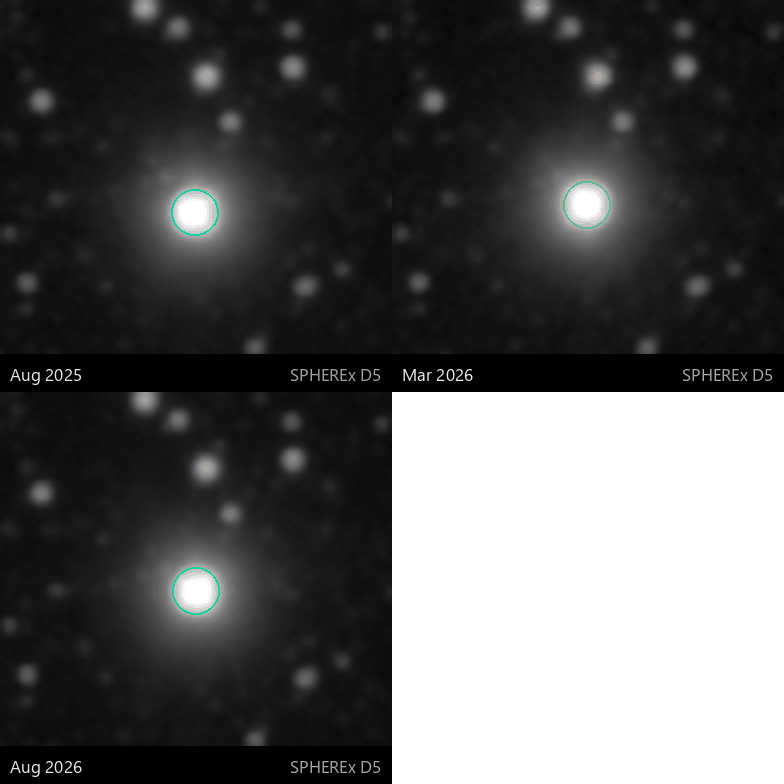
Stars move too, only far more slowly. Of all stars, this is the one whose place in our sky changes fastest: under two SPHEREx pixels a year. The numbers show what the tool makes of it.
What to look for
The images loop through three visits: the star hops north by roughly a pixel each time, following the dotted line. Its core is bright enough to saturate the shorter-wavelength detectors, so D5 gives the cleanest view. The table compares the shift measured from these images with the catalogue prediction.
SPHEREx has 360 exposures of this spot, from August 15, 2025 to September 22, 2026.
Open Barnard’s Star in ChronosphereX
Over a quarter of a century
Sources: SPHEREx, NASA/JPL-Caltech, IRSA · SIMBAD · Gaia DR3 · 2MASS · WISE, NEOWISE · Wikipedia