Young star (T Tauri type) · K
RW Aurigae
A young star, still surrounded by dust, whose brightness changes unpredictably.
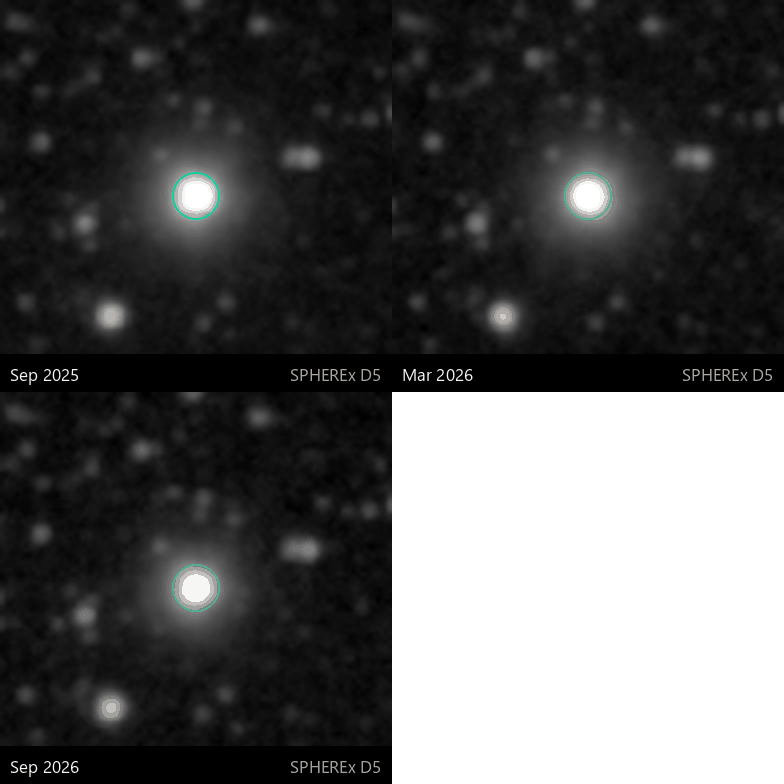
A newborn star still wrapped in dust. It does not move, and the images stay steady. But look at the spectrum, where each colour is one visit: within a year the star grew brighter below 1.6 microns and lost almost half its brightness beyond 4 microns, while the stars around it did not change.
What to look for
The colours in the spectrum are the three visits, and they cross over. From September 2025 to September 2026 the star grew more than 40% brighter below 1.6 microns and lost almost half its brightness beyond 3.8 microns; ordinary stars in the same images stayed constant to about 1%. In its deep fading of 2014 to 2016 astronomers saw the reverse: hot dust near the star hid it while glowing in the infrared.
SPHEREx has 336 exposures of this spot, from September 1, 2025 to September 16, 2026.
Open RW Aurigae in ChronosphereX
Over a quarter of a century
Sources: SPHEREx, NASA/JPL-Caltech, IRSA · SIMBAD · Gaia DR3 · 2MASS · WISE, NEOWISE · Wikipedia